

Bill 148: Consent Order Issued, Frequently Asked Questions (FAQ)

Dear member,
Justice Ann E. Smith has now issued the Court Order in the Bill 148 legal challenge. You can read the Order HERE.
The Order spells out who is eligible to receive compensation in the form of Charter damages from the Provincial government, as well as a timeline for this process.
Please see the up-to-dateFrequently Asked Questions document below.
Note: this FAQ is intended for NSGEU members. If you are a member of a different union affected by Bill 148, we would encourage you to look up resources made available by them. For the purposes of this FAQ, whenever the term “members” is used, it refers to both current and former members.
| Background/The Process 1. What is Bill 148? Bill 148 (the Public Services Sustainability Act) was legislation introduced and passed in 2015 by the McNeil Liberal Government and enacted in 2017. It stripped away the collective bargaining rights of workers in Nova Scotia by imposing fixed wage increases over a four-year period and ended the continued accrual of service awards and retirement allowances.While in Opposition, Tim Houston opposed the legislation and committed to repeal it if he formed government. Once he formed government and became Premier, he reneged on that promise and instead, decided to continue the legal fight, which he ultimately lost. 2. Why did the NSGEU file a Charter Challenge against the Government of Nova Scotia regarding Bill 148? Under the Nova Scotia Federation of Labour (NSFL), the Nova Scotia Government and General Employees Union (NSGEU), Canadian Union of Public Employees (CUPE Nova Scotia & CUPE Local 1867 Highway Workers), Nova Scotia Teachers Union (NSTU), Nova Scotia Nurses Union (NSNU), Unifor, International Union of Operating Engineers (IUOE) Local 727, Services Employees International Union (SEIU) Local 2, and the Canadian Union of Postal Workers (CUPW – EMS) challenged Bill 148 at the Nova Scotia Supreme Court. They argued that Bill 148 interfered with free and fair collective bargaining and as a result, it violated the Canadian Charter of Rights and Freedoms. The Province of Nova Scotia under the leadership of Premier Tim Houston were the respondents to the appeal. 3. How did Bill 148 impact NSGEU members? As part of an austerity push, the McNeil government passed Bill 148, which restrained wages over a four-year period to 0% in year one, 0% in year two, 1% in year three and 1.5% with an additional 0.5% on the last day in year four. Additionally, it eliminated the future accrual of long-service awards/retirement allowances in collective agreements. The negative impact was not limited to workers’ earnings and benefits. It infringed on their Charter protected right to exercise freedom of association. 4. This legal fight has taken more than a decade. What has transpired in that time? It has been a long road to get this legal victory. Please see the graphic below for a timeline on this 11-year battle. |
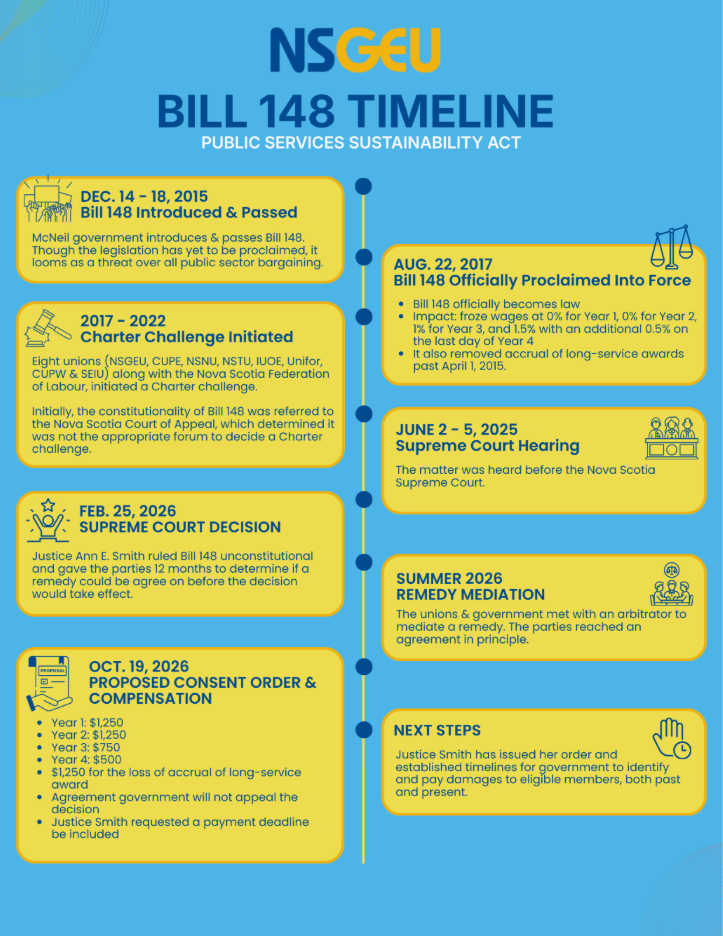 |
| 5. What did the court decide? On February 25, 2026, Justice Ann Smith of the Supreme Court of Nova Scotia declared Bill 148 unconstitutional, ruling that it violated workers’ Charter‑protected rights to meaningful collective bargaining. Justice Smith found: “[…] in removing wages from the items up for negotiation, the Act materially undermined the ability of the Applicant Unions to effectively bargain for their members.” “It is clear to this Court that the removal of the long service awards, along with the wage restraint caps imposed by the Act, had a hugely negative impact on the bargaining power of the Applicant Unions, and thereby their ability to meaningfully negotiate on behalf of their members.” “Bill 148 substantially interfered with the ability of the Applicant Unions to exert meaningful influence over important working conditions through a process of good faith collective bargaining.” “Bill 148 removed the Applicant Unions’ leverage on monetary items and thereby upset the balance of power between the parties and negated the ability of the Unions to engage in meaningful bargaining.” “The evidence shows, and I find that Bill 148 did not respect the principle of the duty to consult and negotiate in good faith.” Remedy Decision 6. Why didn’t the court decision in February 2026 include a remedy for the losses members experienced? In her decision, Justice Smith determined that the declaration of her decision would be suspended for 12 months to allow the parties time to attempt to negotiate a fair remedy. 7. How was remedy decided? With the assistance of an arbitrator, the eight unions and the province entered into mediated discussions on remedy. The unions had predetermined that decisions would be reached by consensus, with no individual party having the authority to unilaterally determine the outcome. Through those discussions the unions and province reached an agreement in principle which was submitted through legal counsel as a proposed consent order to the court on October 16, 2026. On October 19, legal counsel representing the parties made a court appearance before Justice Smith, where she requested some minor clarifying amendments as well as an enforceable payment deadline before she would consider issuing the order. 8. What is the amount of the provincial impact of the remedy? Early estimates indicate that approximately 81,000 workers will be eligible for wage-restraint damages and approximately 55,000 workers will be eligible for service award/retirement allowance damages. The estimated total cost is $470 million, which has been accounted for in the province’s 2025–26 budget. 9. Who ultimately makes the decision on monetary remedy? Because the matter was heard before the Supreme Court, the remedy must flow through an order of the Court under its judicial authority per the Charter of Rights and Freedoms. Due to the fact that this is a Charter remedy, the Court is the only body that can determine the appropriate legal outcome and remedy. In other words, this process was not a democratic one where a vote would occur, and the ultimate decision on remedy rests with the Court. Bearing in mind that the decision impacts tens of thousands of members (past and present), spanning across eight unions, if a vote could have been part of the process it would be an inherently complex, impractical and potentially unreliable process. 10. Will the government appeal? The Order prevents an appeal by government, and it is final and binding to all parties. 11. Why is the remedy being awarded as Charter damages? Charter rights were violated so compensation is intended to be paid as Charter damages. Such damages recognize the infringement of rights, not the specific replacement of lost wages and benefits. 12. What would have happened if the parties did not reach an agreement? Had the parties been unable to reach an agreement on remedy, the matter would have returned to Justice Smith to determine an appropriate remedy. If this occurred, government would have appealed the original constitutional decision. Not only would this have drawn out the process further, but it also would have posed a significant risk to the decision being overturned which would result in no remedy at all. A successful appeal by the government would have left workers open to future legislated attacks on their Charter rights. Additionally, there was no guarantee that Justice Smith would have awarded any damages, as she would have made financial considerations with respect to any monetary remedy, in terms of the province’s ability to pay and remedies awarded in other Canadian jurisdictions. It is important to note that there are several jurisdictions where similar legislation that impacted collective bargaining rights have been found to be constitutional, and therefore there was no award or remedy for impacted workers. Compensation 13. How much will eligible members receive? Compensation is issued as flat-rate Charter damages. The amounts are the same for all eligible members, regardless of salary, job classification, or hours worked. Payments are broken down by the four-year wage restraint period: 1st Year: $1,250 (for the 0% wage restriction) 2nd Year: $1,250 (for the 0% wage restriction) 3rd Year: $750 (for the 1% wage restriction) 4th Year: $500 (for the 1.5% + 0.5% wage restriction). Subject to eligibility requirements, any time worked in any of the four years (including part-time and partial years) will equate to the full lump-sum payment for the given year. The specific four years vary by collective agreement, depending on when the agreement was in effect at the time expired. Long Service Award/Retirement Allowance Impact: Members will receive an additional $1,250 if they lost the future accrual of a service award /retirement allowance. This applies whether or not they previously opted for a payout of a long service award/retirement allowance. For employees who did not opt for a payout, any accrued service award remains intact. No service awards/retirement allowances will be reinstated. The maximum total amount any single person can receive under this order is $5,000. 14. Who is eligible to receive these damages? Any past or present employee appearing on an NSGEU seniority list who was impacted by Bill 148 and worked a full or partial year during the designated four-year period is entitled to general damages for that year. 15. Who is excluded from receiving payments? Deceased individuals/estates are not eligible for payment under this Order.Any employee terminated for cause following the enactment of Bill 148 is not eligible. 16. How will disputes on eligibility be resolved? The arbitrator who mediated the settlement will retain jurisdiction to resolve eligibility disputes. 17. What is the timeline for payment? The Province is responsible for identifying anyone who is entitled to damages. This effort will include creating a list of all persons entitled and encouraging anyone who may be eligible to identify themselves to the Province. By June 30, 2027, they must provide a list of individuals who have been identified as entitled to damages, how much they are entitled to, and provide a means for any individual to review this information. By September 30, 2027, they must have reviewed and corrected any identified errors or omissions in their list. All errors or omissions must be brought forward by this date. The Justice has ordered that all damages under this order must be paid out no later than December 31, 2027. Nothing in the Order prevents the government from paying damages prior to the December 31, 2027 deadline. The process for identifying edibility and entitlement and the means in which it will be publicized is currently being established and will be communicated once determined. 18. Do members and former members, including retirees, need to update contact information or identify themselves now to confirm eligibility for the remedy? No, however we encourage you to watch for future communication on the process. Communication will be shared once the Province has established a clear process for identifying eligibility and updating information. 19. What is the process for seeking compensation? The exact method for how members should identify themselves as being eligible for damages has yet to be determined, but the Province is responsible establishing such a process. Government will provide funding to employers for compensation for all eligible employees. At this point it is unknown when and how payments will be made. 20. What if the amount I am entitled to is inaccurate or I have been left off the list of eligible members? You should make an objection by the September 30, 2027, deadline. The process for making an objection will be communicated once finalized. 21. Will the payment be treated as taxable income? We do not anticipate this payment will be taxable. This is because the money is being issued as court damages, not as regular employment pay, so they are not subject to withholdings. However, the final decision on such matters always remains with the Canada Revenue Agency. These payments are also not subject to union dues. 22. Will this payment affect my LTD, Workers’ Comp, or EI? We do not anticipate any financial impact on eligible employees currently on Long-Term Disability (LTD), Workers’ Compensation (WCB), or Employment Insurance (EI). This is because the money is being issued as court damages, not as regular employment pay. 23. I noticed a reference to a payment that must be made to the Applicant, what does that mean? The government is being made to pay a portion of the unions’ legal fees associated with the hearing process. Eligibility 24. I am retired now, but I worked during the years of wage restraint. Am I entitled? All eligible members, past included, who were employed during the years of wage restraint are entitled to the share of a remedy, so long as they were not terminated for just cause or are not deceased. 25. I was employed by two different employers affected by Bill 148 during this time and/or belonged to more than one union. Does this affect my entitlement? No. However, no individual is entitled to more than one payment of damages with respect to any given year of wage restraint. If you have additional questions regarding the proposed Bill 148 consent order, please email nsgeu_b148@nsgeu.ca. |
Related Articles
-
November 10, 2026
Remembrance Day – NSGEU Offices Closed
Lest we forget those who fought and continue to fight for the rights we enjoy today. From one group of...
-
November 8, 2026
Nurse Practitioner Week, November 8-14
NSGEU is proud to represent many NPs working throughout our healthcare system and want to recognize the important contributions they...
-
November 5, 2026
November 6 is Community Social Service Workers Day
Community services is a sector that is repeatedly underfunded by governments. Many of the services are invisible to the world,...
-
October 30, 2026
Celebrating Allied Healthcare Professionals Recognition Week November 1-7
We’re hitting the road to celebrate our incredible Allied Healthcare professionals and recognize the important work you do every day!...
-
October 30, 2026
NSGEU Podcasts
Episode 1 Allied Healthcare Week 2026 _Interview with Amanda Hemmings Episode 2 Allied Healthcare Week 2026 Interview with Krista Wilson
-
October 30, 2026
Bill 148 Proposed Consent Order: Frequently Asked Questions
Frequently Asked Questions What is Bill 148? Bill 148 (the Public Services Sustainability Act) was legislation introduced and passed in...
-
October 30, 2026
Local 42 – Canadian Blood Services Operations & Support Bargaining Update
Your bargaining committee met with the employer again to continue negotiations on October 15th and 16th, at which time the...
-
October 26, 2026
Local 27 – Evergreen Home for Special Care Bargaining Update: Vote Results
As per the recommendation of your bargaining committee, your local has voted to ACCEPT the tentative agreement. Of those members...
-
October 19, 2026
Province Held To Account for Reckless Bill 148
Province Held To Account for Reckless Bill 148 The labour movement earned an important victory today for the rights of...