
Member Update: Unions Prevail in Bill 148 Charter Challenge

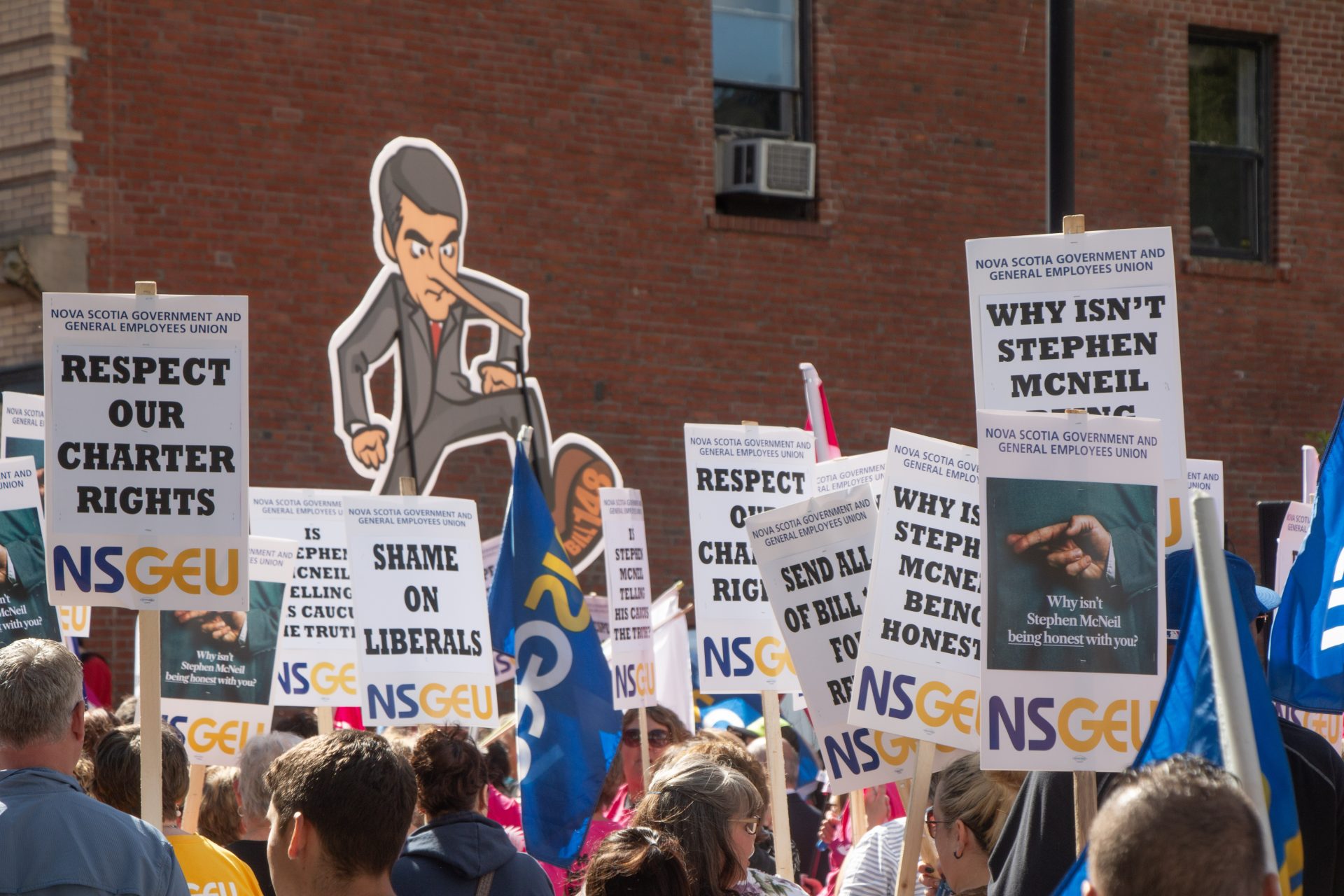
More than a decade after the McNeil Liberal government passed Bill 148, the Supreme Court of Nova Scotia has issued a historic decision that rules government violated the constitutional rights of public sector workers.
“This is a great day for workers’ rights in Nova Scotia,” said NSGEU President Sandra Mullen, “This ruling is the first step towards correcting this historic injustice towards our members, and many others.”
The legislation, which was passed in December 2015, froze the long service award and legislated five years of low wage increases including two zero per cent increases for thousands of public sector workers. As you will recall Bill 148 did three things that directly interfered with your right to full, free collective bargaining:
- It imposed a non-negotiated wage pattern on the entire public sector (0%, 0%, 1.0%, 1.5% & an additional 0.5% on the last day of the agreement);
- It removed long-standing articles from various collective agreements (ending the retirement allowance/public service award as of April 1, 2015);
- Prohibiting an arbitrator from awarding anything above the above-noted wage pattern.
Even before government proclaimed the Bill into force in 2017, the threat of legislation hobbled the unions’ bargaining power and prevented us from being able to freely conclude the collective bargaining process, because it took away the leverage of wages and monetary items like the service award off the table completely. The unions’ argument is that Bill 148 breaches Section 2(d) of the Charter, which guarantees Canadians Freedom of Association and protects the right to collective bargaining and the right to strike.
The unions representing these workers – NSGEU, CUPE, CUPE Local 1867, NSNU, NSTU, Unifor, SEIU, IUOE, and CUPW – came together under the Nova Scotia Federation of Labour (NSFL), committed to fighting this legislation.
Initially, this challenge was delayed when then Premier McNeil referred the legislation to the Court of Appeal for an opinion. The province then made a series of preliminary objections to material being sought by the unions. Once those matters were resolved, the Court of Appeal concluded in 2022 that it was not the appropriate forum to decide whether the legislation breached the Charter.
After ten years, the unions were finally able to make their case to the court in a series of hearings that took place June 2, 3, 4 and 5, 2025.
Tim Houston had promised to repeal Bill 148 when he was campaigning in August 2021. But when he was elected as Premier, he broke that promise and continued to waste taxpayers’ money on this legal challenge, which he has now lost.
“Now, Premier Houston and Premier McNeil can share this stain on their respective legacies,” said Mullen.
The legal battle which ensued spanned almost a decade and included 17 affidavit submissions filed on behalf of the unions, as well as four rebuttal submissions. Ultimately, the judge found in favour of the unions’ arguments on both the issue of wage freezes and removal of the long service award, and completely rejected the government’s argument.
The ruling notes that “the fiscal implications of an immediate declaration of invalidity would likely be considerable,” so they are allowing government an additional 12 months to find a remedy, but the judge has reserved jurisdiction on the case to order a remedy, if required.
Government may appeal this decision, but we hope they will finally choose to do the right thing and work with the unions to ensure we achieve the best possible remedy for all members.
We thank all members for your support as we navigated this decade-long fight! We ask that you remain patient as we move forward to the remedy phase of the legal process.
Solidarity!
Here is our legal counsel’s summary of the decision, along with the full decision:
Justice Ann E. Smith of the Nova Scotia Supreme Court has issued a decision declaring that Bill 148 – the Public Services Sustainability (2015) Act – substantially interfered with the s.2(d) Charter right to a process of good faith collective bargaining.
Section 2(d) of the Charter says that one of the fundamental freedoms that everyone has is the freedom of association. This includes the right to collective bargaining.
The Court held that Bill 148’s elimination of Service Awards and imposition of wage restraint, including a wage freeze, substantially interfered with collective bargaining, contrary to the Charter. The Court found that Bill 148 did not reflect the principle of Government’s duty to consult and negotiate in good faith.
The Court further found that Government failed to demonstrate that Bill 148 amounted to a reasonable limit to that right pursuant to s.1 of the Charter. In particular, the Court held that Government did not show that Bill 148 was tailored to impair rights no more than necessary.
The Court therefore declared Bill 148 to be unconstitutional and of no force and effect pursuant to s. 52(1) of the Constitution Act, 1982. Section 52 of the Constitution says that “any law that is inconsistent with the provisions of the Constitution is, to the extent of the inconsistency, of no force or effect.” The Court has suspended the declaration for a period of twelve months to allow Government to consider the fiscal implications of the declaration.
The Court has remitted the question of any further remedy under s.24(1) of the Charter to the parties and reserved jurisdiction should the parties be unable to resolve the issue. Section 24 of the Charter provides the Court with a broad jurisdiction to grant “such remedy as the court considers appropriate and just in the circumstances” to anyone whose rights or freedoms under the Charter have been infringed.
“[…] in removing wages from the items up for negotiation, the Act materially undermined the ability of the Applicant Unions to effectively bargain for their members.”
“It is clear to this Court that the removal of the long term service awards, along with the wage restraint caps imposed by the Act, had a hugely negative impact on the bargaining power of the Applicant Unions, and thereby their ability to meaningfully negotiate on behalf of their members.”
“Bill 148 substantially interfered with the ability of the Applicant Unions to exert meaningful influence over important working conditions through a process of good faith collective bargaining.”
“Bill 148 removed the Applicant Unions’ leverage on monetary items and thereby upset the balance of power between the parties and negated the ability of the Unions to engage in meaningful bargaining.”
“The evidence shows, and I find that Bill 148 did not respect the principle of the duty to consult and negotiate in good faith.”
Related Articles
-
March 30, 2026
Locale 72: Mise à jour des négociations: Session d’information et vote de ratification prévus
Comme indiqué dans notre dernier courriel, votre comité de négociation est parvenu à un accord avec votre employeur le 11 mars...
-
March 17, 2026
Defending Public Health Care Against the Precedent of Alberta’s Bill 11
On Monday, March 16, the NSGEU hosted a press conference for the NS Health Coalition and the Canadian Health Coalition....
-
March 16, 2026
Local 29 – VON Schedulers Bargaining Update: Conciliation Date Set
Bargaining has been very slow and frustrating for your entire committee, and we understand your frustration. We anticipated an additional...
-
March 5, 2026
Union Files Grievance Over End of Remote Work
This week the union filed a policy grievance in response to the government directive that ends remote work arrangements and...
-
March 5, 2026
Local 82 – NSCAD What To Do If a Union at Your Workplace Goes On Strike?
Teaching assistants at the Nova Scotia College of Art and Design are now on strike after negotiations with the employer...
-
March 2, 2026
Local 38 Northwood Schedulers: Bargaining Update: Filing for Conciliation
Bargaining has been very slow and frustrating for your entire committee, and we understand your frustration. We anticipated an additional...
-
March 2, 2026
A Letter from the President
As you are aware, Premier Tim Houston introduced a damaging budget that directly threatens the livelihoods of hundreds of public sector...
-
February 27, 2026
MEDIA RELEASE: Unions Prevail in Bill 148 Charter Challenge
(Dartmouth) – More than a decade after the McNeil Liberal government passed Bill 148, the Supreme Court of Nova Scotia...
-
February 26, 2026
Section locale 72 – Conseil scolaire acadien provincial: Mise à jour des négociations
Votre comité de négociations avait rencontré avec l’employeur mardi et mercredi de cette semaine. C’était encore des jours de négociations...